Jewish Ethics Here and Now
  • Home
  • for students
    • Experiential assignments >
      • Mussar experiential assignment
      • climate change experiential assignment
      • Peacemaking within ourselves
    • canvas
    • tips for students
  • Issues
    • Social media and shaming
    • "fake news"
    • whistleblowing
    • workplace ethics
    • Violence and peacemaking
    • Climate Change
    • public safety
  • Jewish ethical concepts
    • pikuach nefesh: saving a life
    • kvod habriyot: human dignity
    • geneivat da'at: honest representation
    • lashon hara: ethical speech
    • lifnei iver: stumbling block
    • bal tashchit: do not waste
    • tochecha: rebuke
    • mussar: jewish character ethics
    • tzedek: justice
  • Resources
    • what's applied ethics? >
      • Applied Ethics etext
    • Sample Syllabus
    • learn about Judaism >
      • Judaism basics >
        • The Torah
      • Jewish religious diversity in the U.S.
      • jewish communities around the world
      • antisemitism
      • the pluralism project
    • ethical wills
    • social science and ethics

violence and peacemaking

What is violence?
What do we know about violence in our society?
What do Jewish sources say about our responsibilities concerning violence?
How can we practice peacemaking and reduce violence?

i. definitions

Picture
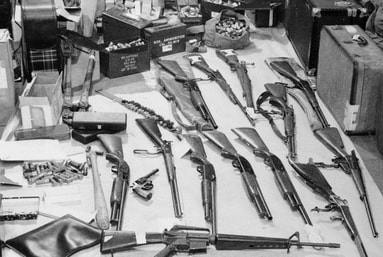
Guns and ammunition seized from members of the Black Panther Party in a 1974 arrest by Oakland and Berkeley police

ii. experiences

Picture
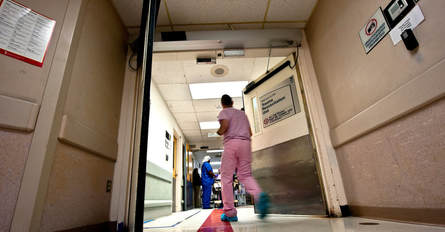
A C-STARS student rushing to help accident victims in a Maryland shock trauma center
​Larry Ray, 2011. “What is Violence?” Chap. 1 of Violence and Society. Los Angeles: Sage.
  • What may make an action count as violence, and when might the same action not be regarded as violence? 
  • Can violence be explained as a part of human evolution? Why or why not?

Elisabeth Rosenthal, “More guns = more killing.” New York Times, Jan. 5, 2013.
  • How has the presence of “good guys with guns” affected the Latin American societies described in this article?

​Andrew Solomon, “Anatomy of a murder-suicide.” New York Times, Dec. 22, 2012.
  • What is the relationship between violence and despair, according to this article?
  • What is the relationship between mental illness and suicide, according to this article?

David Cole, “Who pays for the right to bear arms?” New York Times, Jan. 1, 2013.
  • In what ways are there racial disparities in gun violence?
  • What does race have to do with gun laws?

Mike Spies. “When a bullet enters a body: gun violence as seen by a trauma surgeon.” The Trace. Sept. 21, 2015.
  • According to Dr. Newman, what happens to human bodies when they are shot?
  • How does the kind of gun affect the wounds that a victim sustains?

Brenda Gazzar, “LAPD hosts first Jewish community forum in the San Fernando Valley,” Los Angeles Daily News, June 19, 2014.
  • Why is the San Fernando Valley Jewish community concerned about security?

iii. social-scientific questions

Picture
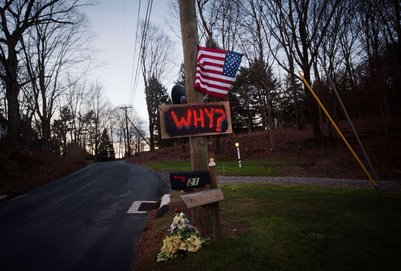
A memorial to the victims of the 2012 Sandy Hook Elementary School Massacre
Jay Dickey and Mark Rosenberg, “We won’t know the cause of gun violence until we look for it.” Washington Post, July 27, 2012.
  • Why do we know more about preventing traffic fatalities than about preventing gun violence?

Megan Murphy, “What is it about men that they’re committing these horrible massacres?” AlterNet, December 18, 2012.
  • Why does the author think there should be a conversation about men and violence?
  • According to Jackson Katz, what does violence have to do with masculinity?

Rin Kelly, “Do media vultures perpetuate mass shootings?” Salon, Dec. 29, 2012.
  • What are the problems with media coverage of mass shootings, according to the article?
  • What would be a better way for media to cover mass shootings, according to the article?

Deen Freelon, Charlton D. McIlwain, and Meredith D. Clark. 2016. "Beyond the hashtags: #Ferguson, #Blacklivesmatter, and the online struggle for offline justice." Center for Media & Social Impact. School of Communication. American University. Washington, DC.
  • How did the Black Lives Matter movement use online media to generate a national discussion about police killings of unarmed Black citizens?
  • What sources of data did the authors use to conduct their study of Black Lives Matter and digital media?
  • What are "unaligned parties," according to the article?
  • How has social media been a force for ethics in the BLM movement?

Rachel Yehuda, "How trauma and resilience cross generations." On Being with Krista Tippett. July 30, 2015.

iv. Jewish perspectives

Picture
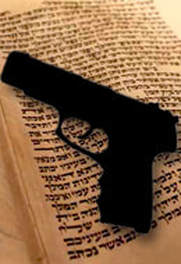
Click the image to read Shlomo M. Brody's "Gun control and the limits of halakhah."
Mark Katz, "The Jewish view on weapons," Tablet, Dec. 19, 2012.
  • What cases did the rabbis discuss that we can apply to a contemporary discussion about guns? In what ways do these cases apply?
  • What does Marc Katz think these texts suggest that we should do about guns today?

Shlomo M. Brody, "Gun control and the limits of halakhah," Jewish Ideas Daily, Jan. 9, 2013.
  • Under what circumstances does the 18th century rabbi Ezekial Landau think it is permissible for Jews to hunt for sport with guns? What is his reasoning?
  • How does the author think this 18th century rabbi’s opinions apply to the contemporary debate about gun control?

Aaron Alexander, "Unnecessary danger: a reflection on guns, violence, and personal safety." Huffington Post, Dec. 21, 2012.
  • What is "the Jewish perspective" on self-defense? From what Jewish sources does this perspective come? 
  • Does Jewish law give a straightforward answer about what we should do about guns? Why or why not?

Ilise Benshushan Cohen, Aurora Levins Morales, and Rebecca Vilkomerson. 2016. "American Jews should support the Movement for Black Lives platform." The Nation.
  • What is the Movement for Black Lives platform?
  • Why have some Jewish organizations disapproved of the MBL platform?
  • Why do the authors of this article think that these organizations should overlook the use of the word "genocide" in the MBL platform?
  • How do the authors of this article recommend that white people demonstrate solidarity with people of color?
  • How do different Jewish and black experiences of violence resonate and conflict in this article?
  • Why do the authors argue that "the usual narrative of black/Jewish relations" is wrong?

Collection of Jewish rabbinical sermons that address peacemaking. 

Ruling by the Committee on Jewish Law and Standards of the Conservative Movement on the question of whether Jews may play violent or defamatory video games.

Toby Myers. 2009. "Jewish Perspectives in Domestic Violence." 

v. more resources

Picture
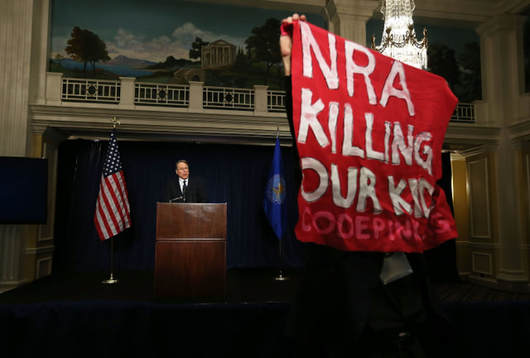
National Rifle Association CEO Wayne LaPierre interrupted by protesters in the wake of the 2012 Sandy Hook Massacre
Violence and gender
  • Bianca Hasten. "Sexual and domestic violence against Jewish women." Feminist Sexual Ethics Project. Brandeis University. 
  • Bessel van der Kolk, "Restoring the body: Yoga, EMDR, and treating trauma." On Being with Krista Tippett. Oct, 30, 2014.
  • Chauncey DeVega. "White Men Like Adam Lanza Commit 70 Percent of the Mass Shootings in the United States. Why is the Media Afraid to Talk About This Obvious Fact?" Indomitable. Dec. 15, 2012.
Violence and politics
  • Nicholas Kristof. "Do We Have the Courage to Stop This?" The New York Times, Dec. 15, 2012.
  • Nicholas Kristof. "Is Delhi So Different From Steubenville?" The New York Times, Jan. 12, 2013.
  • Samuel L. Adams. "The Newtown Tragedy and the Prophetic Case for Immediate Action." Huffington Post. Dec. 16, 2012.
  • Benjamin R. Freed. "Head of NRA Pins Connecticut Massacre on Politicians, Monsters and Media, But Not Guns." DCist. Dec. 21, 2012.
  • ​"Sacrificing Our Children in the Name of the Second Amendment." Art on Issues. Jan. 10, 2012.
  • Firmin DeBrabander. "The Freedom of an Armed Society." The New York Times. Dec. 16, 2012.
Violence and mental health
  • "In the aftermath of a shooting." American Psychological Association. Apr. 2011.
Other topics
  • "The Scourge of Concealed Weapons." The New York Times. Dec. 22, 2012.
  • Juliet Lapidos. "America's Gun Stockpile." The New York Times. Dec. 17, 2012.
  • David H. Newman. "​At the E.R., Bearing Witness to Gun Violence." The New York Times. Jan. 1, 2013.
  • "Readers Respond to the 'Armed Society' Series on Gun Control." The New York Times. Dec. 30, 2012.
  • ​Nicholas Kristof. "Looking for Lessons in Newtown." The New York Times. December 19, 2012.
  • Kent Annan. "Bullshit National Grieving." Huffington Post. Dec. 16, 2012.
  • Adam Winkler. "The Secret History of Guns." The Atlantic. Sep. 2011.
  • Garry Willis. "Our Moloch." NYR Daily. Dec. 15, 2012.
  • Ezra Klein. "Twelve facts about guns and mass shootings in the United States." The Washington Post. Dec. 14, 2012.
Proudly powered by Weebly
Photo from Seanie2322
  • Home
  • for students
    • Experiential assignments >
      • Mussar experiential assignment
      • climate change experiential assignment
      • Peacemaking within ourselves
    • canvas
    • tips for students
  • Issues
    • Social media and shaming
    • "fake news"
    • whistleblowing
    • workplace ethics
    • Violence and peacemaking
    • Climate Change
    • public safety
  • Jewish ethical concepts
    • pikuach nefesh: saving a life
    • kvod habriyot: human dignity
    • geneivat da'at: honest representation
    • lashon hara: ethical speech
    • lifnei iver: stumbling block
    • bal tashchit: do not waste
    • tochecha: rebuke
    • mussar: jewish character ethics
    • tzedek: justice
  • Resources
    • what's applied ethics? >
      • Applied Ethics etext
    • Sample Syllabus
    • learn about Judaism >
      • Judaism basics >
        • The Torah
      • Jewish religious diversity in the U.S.
      • jewish communities around the world
      • antisemitism
      • the pluralism project
    • ethical wills
    • social science and ethics